

Barney Frank and Me
The liberal icon and I crossed paths twice, early in my career

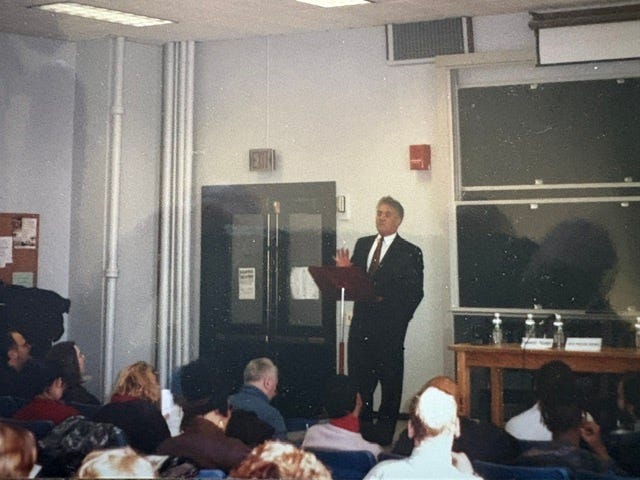
Congressman Barney Frank (D-Mass.) addresses an anti-sexist men’s conference at M.I.T., circa 1995
By Jackson Katz
I didn’t know the late Barney Frank personally, though I did meet him briefly a couple of times. The longtime congressman and political curmudgeon, who died on May 19 at age 86, played a significant role in the early days of my political activism.
My first encounter with the charismatic politician occurred in late 1981, when I was a senior in college. My mother brought me along to a fundraiser for him at a private home in Brookline, Massachusetts, when he was seeking re-election to Congress for the first time.
I was already a veteran of progressive organizing on my large public university campus. But aside from my high school days, when I was adjacent to my mother’s activities with the League of Women Voters and some local races in my hometown on Boston’s North Shore, I was new to the world of political campaigns and electoral politics.
As I listened to Frank speak to the group of largely white, highly educated, and disproportionately Jewish people crowded into the living room of one of his supporters, I was impressed with his quick mind and acerbic wit, and his unabashedly liberal politics. He was a fighter in the halls of power for working people, women’s rights, and racial justice, and he didn’t back down.
This was especially attractive to young progressives and feminists like me and my friends, who were horrified and depressed by the disastrous turn the country had taken in 1980 with the election of the reactionary – and plutocrat-friendly -- Ronald Reagan.
At the fundraiser, I wrote my phone number on a sign-up sheet – as one did in the pre-internet Dark Ages. Not long after, someone from his campaign called to see if I wanted to volunteer.
It so happened that Frank’s district had recently been redrawn when Massachusetts lost a congressional seat. So instead of a largely liberal, suburban district just outside of Boston and points west, Frank’s new district reached to the southeast, and included large parts of the blue-collar cities of Fall River and New Bedford.
Frank was set to face off against incumbent Congresswoman Margaret Heckler, a moderate Republican and pioneering woman in politics. Heckler supported the Equal Rights Amendment but opposed abortion rights, and she voted for Reagan’s deeply regressive tax and spending proposals.
A year before, I had co-founded a mixed-gender student organization on my campus to defend women’s reproductive freedom and advocate for broader gender and sexual equality. This was in direct response to the rise of the radical right, and specifically the rabidly anti-feminist agenda of Jerry Falwell’s Sr.’s Moral Majority organization that was gaining political momentum in the early years of the Reagan Administration.
The Frank campaign wanted volunteers to meet voters in the newly configured district. So we organized a contingent of five or six scruffy college students in beat up old cars and drove to Fall River one Saturday in the spring to canvass working-class neighborhoods, hand out flyers, and engage potential voters in conversation. We spent a long day walking down gritty streets filled with triple-decker homes on narrow lots with houses close together, talking to whomever would answer the door. Who knows if we made an impact or won any votes.
All these years later I don’t remember any specific interactions I had that day, or on the return trip some weeks later. But I do recall the way I felt about my experience, at age twenty-one, of knocking on doors for a socially liberal congressman in a largely white and traditional working-class community, and how it made me think about the central role that class played in American politics.
At the time, I had learned a great deal about contemporary American history and politics both in the classroom, and in my progressive activist networks. But I was just awakening to the reality that millions of white, blue-collar voters nationwide had abandoned, or were in the process of abandoning, their traditional home in the Democratic Party and transferring their allegiance to the Republicans.
I was in college and upwardly mobile, but I came from a working-class family myself. It blew my mind then -- and to some extent, still does -- that so many of my working and middle-class compatriots would even consider backing the party that crushes labor unions and eviscerates programs that seek to improve the lives of working people, and whose main legislative priority is tax cuts for the wealthy.
Ever since, I’ve been obsessed with trying to understand class consciousness and political ideology – and the critical ways in which questions of race, gender, and sexual identity both shape it, and are shaped by it.
For the record, Frank beat Heckler in a 60%-40% landslide.
Barney Frank headlined our anti-sexist men’s conference at M.I.T.
My second encounter with Barney Frank came in the mid-1990s. I was leading Real Men, an anti-sexist men’s group I started in Boston in 1988. Among its many activities over a ten-year period, the group raised money for domestic and sexual violence programs; handed out leaflets at Red Sox and New England Patriots football games; organized an abortion speak-out for pro-choice men; sponsored panel discussions about the masculinity politics of militarism and war, the role of men in women-led movements for reproductive justice, the politics of the “mythopoetic” men’s movement that emerged in the early 1990s; and much more.
Circa 1995, we organized a conference, held at M.I.T., about the critical role of men in the prevention of men’s violence against women. About 150 people attended from throughout the Boston area.
People who follow my work know that I’ve long been part of the anti-sexist men’s movement. Alas, to this day, many people don’t even know that this small but scrappy movement even exists. You rarely read or hear about it in legacy media, or in heavily trafficked areas of new media. But men -- both as individuals and in groups -- have been active on these issues since the 1970s.
Things have changed a bit, but it’s still not very common to hear explicitly anti-sexist — or profeminist — men’s voices in public spaces. It was even more unusual in the 1990s. Of course we knew this, so in order to amplify the reach of a conference like the one we were planning at M.I.T., and potentially draw media coverage, we wanted to secure the participation of a high-profile cultural or political figure. So we reached out to Frank’s congressional office, and they said yes.
Congressman Barney Frank was the keynote speaker at the Real Men conference on gender-based violence.
Frank had come out as gay in 1987, the first member of Congress to voluntarily come out while serving in office. So by the mid-1990s he was not only an important – and highly quotable – spokesperson for the broader liberal/progressive agenda. He was also a powerful public voice on LGBTQ issues.
In his inimitable style of seriousness laced with humor, Frank spoke about how important it is for members of dominant groups to support the basic liberal values of justice, fairness, and equality by speaking up for the rights and dignity of people from marginalized or minoritized groups. I don’t recall him saying anything particularly groundbreaking, but we were all quite pleased nonetheless. His presence at our event lent it an air of importance and gravitas.
A coda to this essay: Barney Frank’s last book, scheduled to be published posthumously in September, 2026 by Yale University Press, is entitled The Hard Path to Unity: Why We Must Reform the Left to Rescue Democracy.
According to the publisher, Frank offers “a timely analysis of how liberals in the United States and other democracies lost support to xenophobic populism—and how they can find their way back…Combining history and policy insight with his characteristic humor, Frank offers a strategic path toward reclaiming a just and democratic future by decreasing economic inequality and addressing social problems without alienating the majority of voters.”
Some of the flashpoint issues for the left that he takes on: immigration, policing and sexual identity.
Throughout his long political career, Barney Frank always positioned himself as both visionary and pragmatic. He also knew a lot about how the “sausage is made” in the halls of Congress. Ten years into the Trump Era, his last book is sure to be an interesting and provocative read. Too bad he won’t be there in person to debate his critics and deliver pithy quotes for the masses.
Thanks for sharing. Barney was always a value-add in any room. Circa 1974-75 I spent a month as a high school intern at the MA Statehouse. My desk was between Barney Frank and Mel King. Those were the days
He was better than most. Too bad he apparently succumbed to trans ideology later in life.